

Two Mathematics PhD Students Successfully Defend Dissertations
Congratulations to Ellie Stephens and John Stephens on successfully defending their dissertations and completing the requirements for their Ph.D. in Mathematics. Both students will graduate this December. We congratulate them on this outstanding achievement and wish them continued success in their future endeavors.
Ellie Stephens
Advisor: Dr. Jonathan Meddaugh
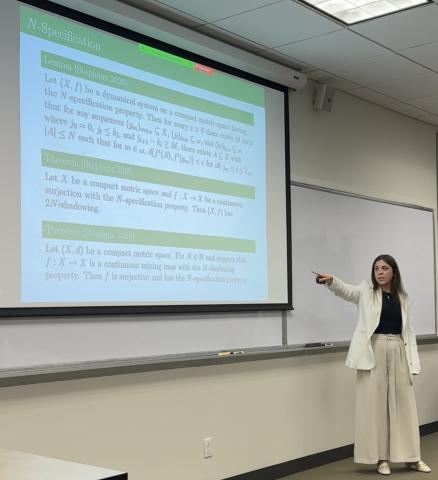
Title: Local Variations of Shadowing
Abstract: For dynamical systems with the shadowing property, pseudo-orbits (sequences with a small error at each term) are approximated by true orbits. This pseudo-orbit tracing makes shadowing a desired property in dynamical systems. As a way of describing systems that exhibit shadowing-like behavior, many authors have defined and studied variations of shadowing. While many of these variations describe the global behavior of a system, crucial information about the origin of a specific pseudo-orbit is lost. As a way to retain this information, we define local variations of the shadowing property. Specifically, we define the neighborhood N-shadowing property for which pseudo-orbits are traced by finite sets of small diameter. We discuss this property in the context of subshifts and arbitrary compact dynamical systems. We also discuss local variations of the thick shadowing property and consequences thereof. Finally, we turn our attention to shadowing as a local property in the space of continuous functions on a compact metric space and show that it is a generic property for spaces retractable onto graphs.
John Stephens
Advisor: Dr. Rob Kirby
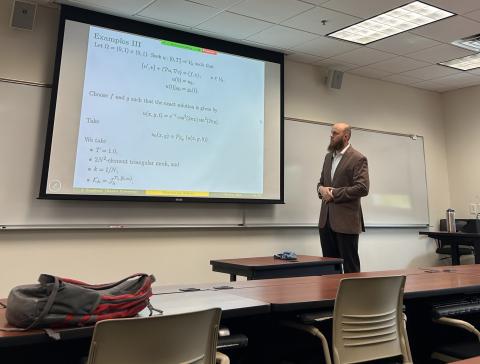
Title: Bounds-Constrained Finite Element Approximation of Time-Dependent Partial Differential Equations
Abstract: Finite elements provide accurate and efficient methods for approximating solutions to partial differential equations. However, these methods do not natively satisfy bounds constraints which may be inherent in the original problem. We present two techniques for enforcing such bounds. The first is a post-processing technique which can be combined with most existing time-stepping methods. The second replaces the traditional time-discrete variational problem with a constrained variational inequality. We formulate the second approach for multistep methods, a class of low-order Runge–Kutta methods, and collocation-type implicit Runge–Kutta methods. For collocation methods, the constraints may be enforced either at the Runge–Kutta stages or, using a novel reformulation of the collocation polynomial, uniformly in time. Extensions are also given for Galerkin-in-time techniques and multistep collocation methods.
These techniques select an approximation from a set of functions that satisfy the prescribed bounds. Solving nonlinear optimization problems, though incurring an additional computational expense, bypasses known order barriers for linear methods and allows for high-order, bounds-constrained integration techniques.